

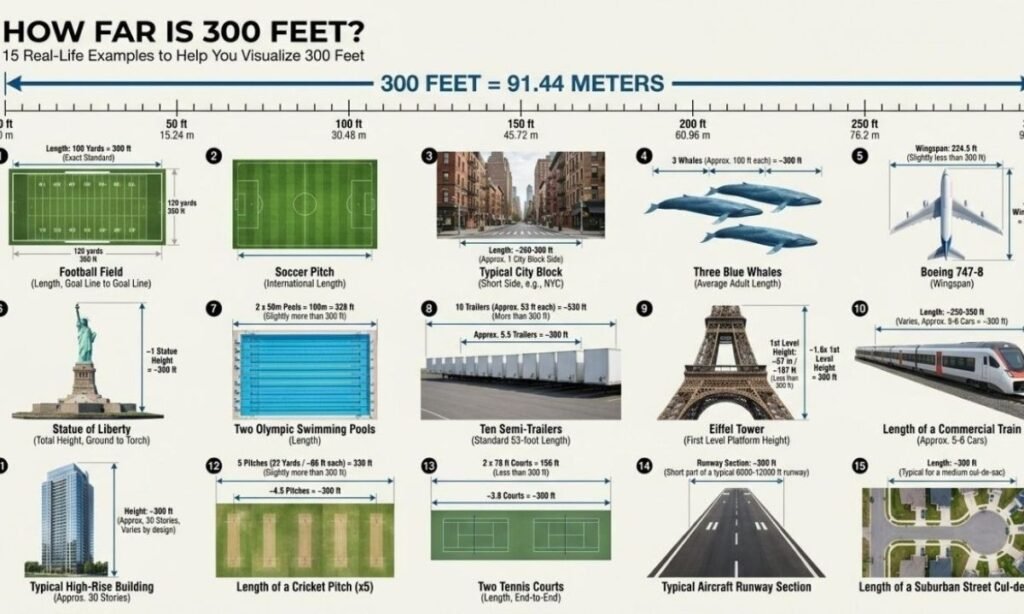
Three hundred feet is one of those distances that sounds simple on paper but is surprisingly hard to picture in real life. Is it a short stroll across a parking lot, or something closer to a full city block?
If you’ve ever asked yourself how far is 300 feet, you’re not alone it’s a distance that shows up constantly in everyday life, from property lines and hiking trail markers to sports fields and building heights.
In plain terms, 300 feet is the length of a football field between the goal lines, or roughly the height of a 30story building. It’s long enough that you can’t easily shout across it, but short enough that most people can walk it in about a minute. Understanding a distance like this is much easier when you connect it to things you already know.
This guide breaks down exactly how far 300 feet really is, with simple unit conversions, side-by-side comparisons to familiar objects, walking-time estimates, and answers to the most common questions people ask about this measurement. By the end, you’ll have a clear, practical sense of what 300 feet looks and feels like in the real world.
Quick Conversion / Measurement Reference
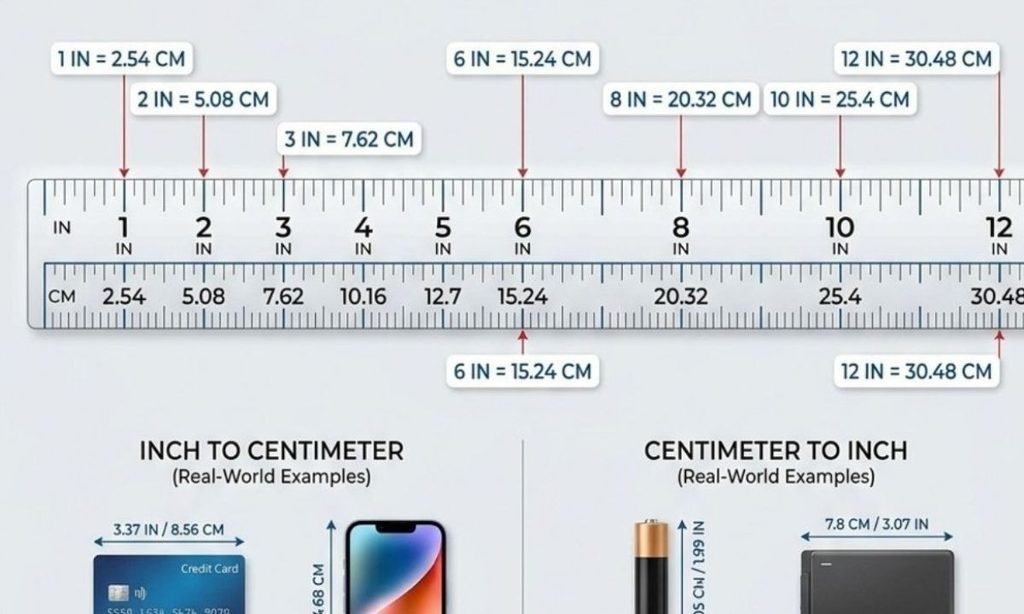
Before diving into comparisons, here’s how 300 feet translates into other common units of measurement.
| UNIT | VALUE |
| Feet | 300 ft |
| Yards | 100 yd |
| Meters | 91.44 m |
| Centimeters | 9,144 cm |
| Millimeters | 91,440 mm |
| Inches | 3,600 in |
At its core, 300 feet is exactly 100 yards the same distance as the length of a football field between the goal lines. It’s also just over 91 meters, making it a useful benchmark whether you’re working in imperial or metric units.
Related Post: How Long Is 11 Inches? 19 Real-Life Objects, Comparisons & Full Conversion Guide
Quick Reference Table
Here’s a fast side-by-side look at how 300 feet compares to everyday objects and structures.
| ITEM | APPROXIMATE LENGTH / SIZE | HOW CLOSE TO 300 FEET |
| Football field (goal line to goal line) | 300 ft | Exact |
| Statue of Liberty (base to torch) | ~305 ft | Very close |
| Big Ben tower | ~315 ft | Very close |
| Space Needle | 605 ft | Roughly half |
| Blue whale | 80–100 ft | Three end to end ≈ 300 ft |
| Standard city block | 300–325 ft | Very close |
| School bus | ~30–35 ft | Ten in a row ≈ 300 ft |
| Passenger car | ~15 ft | Twenty in a row ≈ 300 ft |
What Does 300 Feet Look Like?
Picture standing at one end zone of a football field and looking toward the opposite end zone that’s 300 feet. It’s far enough that a person standing at the other end would look small, and you’d likely need to raise your voice to be heard clearly. It’s also roughly the distance covered by a 30-story skyscraper if you measured straight up instead of across.
Because 300 feet sits in that “medium-long” range, it helps to anchor it to something you’ve physically stood in front of, like a sports field, a city block, or a tall building. Once you have one reference point locked in, the rest of the comparisons in this guide will click into place quickly.
A side-by-side illustration showing a football field, the Statue of Liberty, and a row of parked cars all measuring 300 feet. Suggested Image Alt Text: “300 feet size comparison diagram”
How Long Does It Take to Walk 300 Feet?
Walking 300 feet doesn’t take long, but the exact time depends on your pace, terrain, and whether you’re walking casually or briskly.
Average Walking Time for 300 Feet
At an average walking speed of about 3 miles per hour (roughly 4.4 feet per second), covering 300 feet takes approximately 68 seconds, or a little over one minute. A brisker pace can shave that down closer to 45–50 seconds, while a leisurely stroll might stretch it to closer to 90 seconds.
How Many Steps Are in 300 Feet?
Most adults have an average stride length of about 2.5 feet. That means walking 300 feet takes roughly 120 steps. Someone with a longer stride might cover it in closer to 100 steps, while a shorter stride could push that number closer to 140.
13 Real-Life Examples of 300 Feet
Numbers and conversions are useful, but real-world comparisons make a distance like 300 feet much easier to visualize. Here are 13 examples that bring this measurement to life.
1. Statue of Liberty
From its base to the tip of the torch, the Statue of Liberty stands about 305 feet tall — almost exactly 300 feet. If you flipped the entire monument on its side, it would stretch just slightly farther than the length of a football field.
2. Three Blue Whales
Blue whales are the largest animals on Earth, typically measuring 80 to 100 feet long. Line up three of them nose to tail, and you’d cover almost exactly 300 feet.
3. Big Ben Belfry Level
London’s famous clock tower, Big Ben, rises to about 315 feet at its peak. The belfry level, where the bells are housed, sits close to the 300-foot mark, making the tower a solid real-world benchmark for this distance.
4. Space Needle Mid-Height
Seattle’s Space Needle stands 605 feet tall. The halfway point of the structure — roughly 300 feet up — lands right around the base of its distinctive saucer-shaped top section.
5. Football Field (Goal Line to Goal Line)
This is the most precise comparison available: the distance between the two goal lines on a standard American football field is exactly 300 feet, or 100 yards.
6. Two Olympic Swimming Pools
An Olympic-sized swimming pool measures 164 feet long. Two of them placed end to end come out to about 328 feet a close approximation of 300 feet.
7. Four Tennis Courts End to End
A regulation tennis court is 78 feet long. Four courts lined up end to end stretch about 312 feet, just slightly beyond the 300-foot mark.
8. Ten School Buses Parked End to End
A standard school bus measures roughly 30 to 35 feet in length. Ten of them parked bumper to bumper add up to almost exactly 300 feet.
9. Three Basketball Courts End to End
An NBA basketball court is 94 feet long. Three courts placed end to end come out to about 282 feet, a close match for 300 feet.
10. A Boeing 747’s Wingspan Plus a Bit More
The wingspan of a Boeing 747 is about 211 feet. Add roughly another third of that length, and you’d reach the 300-foot mark useful for picturing large-scale distances like runway or airport measurements.
11. Six Semi-Trucks Parked End to End
A semi-truck with a trailer typically measures 45 to 53 feet long. Six of them parked end to end stretch close to 300 feet, similar to a long line of trucks at a loading dock.
12. Twenty Parked Cars
The average passenger car is about 15 feet long. Line up twenty cars bumper to bumper in a parking lot, and you’ll have covered almost exactly 300 feet.
13. One City Block
In many U.S. cities, a standard city block measures somewhere between 300 and 325 feet, making it one of the most intuitive everyday comparisons for this distance.
Related Post: Pokémon Card Dimensions: Exact Measurements, Sizes, and Comparisons in CM, MM, and Inches
How Big Is 300 Feet Compared to Common Objects?
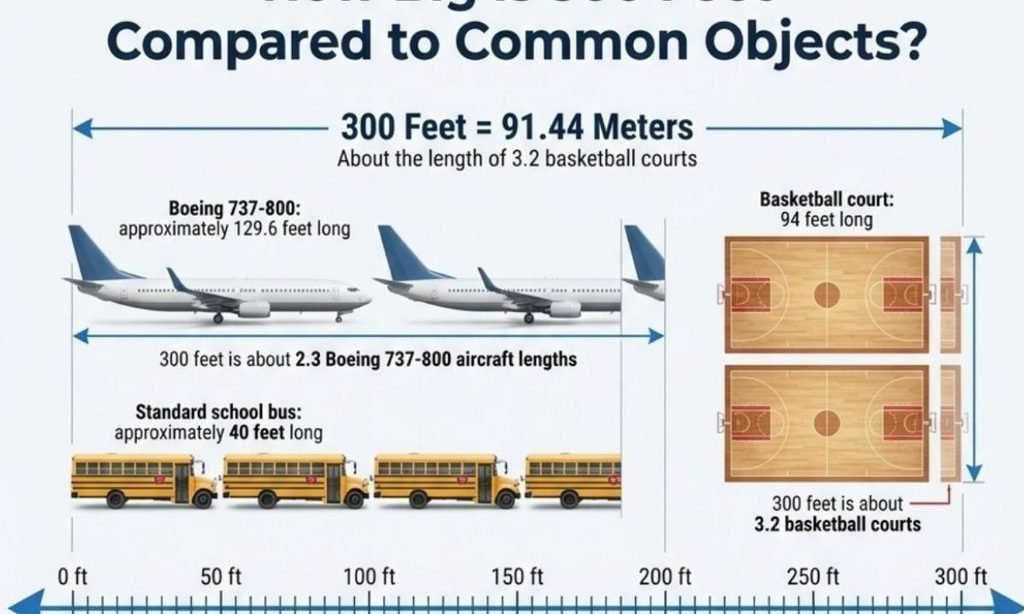
Beyond the individual examples above, it helps to zoom out and compare 300 feet against broader categories of everyday objects and spaces.
300 Feet Compared to a Building
A building’s height depends heavily on its design, but 300 feet is roughly equivalent to a 25–30 story structure using standard commercial ceiling heights of about 10–12 feet per floor.
300 Feet Compared to a Sports Field
As noted earlier, 300 feet is the exact length of a football field between the goal lines, and it’s also close to the length of a full soccer pitch, which typically ranges from 330 to 360 feet.
300 Feet Compared to Cars
Twenty standard cars, or roughly ten larger SUVs and trucks, parked end to end will span approximately 300 feet a useful mental image for estimating parking lot or roadway distances.
How Many Steps Is 300 Feet?
Steps for an Average Adult
For most adults, walking 300 feet takes between 110 and 130 steps, depending on stride length and walking speed.
Walking Stride and Distance
Stride length varies by height and walking style, but the average adult stride covers about 2.5 feet. Taller individuals or those walking briskly may cover 300 feet in noticeably fewer steps, sometimes closer to 100.
How Many Yards and Meters Are in 300 Feet?
300 Feet in Yards
Since one yard equals three feet, 300 feet converts to exactly 100 yards a clean, easy-to-remember figure that matches the length of a football field.
300 Feet in Meters
Using the standard conversion of 0.3048 meters per foot, 300 feet equals approximately 91.44 meters, just short of the symbolic 100 meter mark used in track and field.
How Long Is 300 Feet in Everyday Life?
Visualizing 300 Feet at a Glance
Whether you’re picturing a football field, a city block, or twenty cars parked in a row, 300 feet consistently lands in the range of “one full block” or “one full field” a distance you can see clearly but not comfortably shout across.
Easy Ways to Estimate 300 Feet
- Count roughly 120 average walking steps.
- Picture one full football field between the goal lines.
- Picture ten school buses parked bumper to bumper.
- Picture one standard city block.
Measuring 300 Feet Without a Ruler
You don’t need a tape measure to get a reasonably accurate sense of 300 feet. Everyday objects and simple counting methods can get you very close.
Practical Comparison Table:
| REFERENCE OBJECT | APPROXIMATE SIZE | HOW IT HELPS |
| Football field | 300 ft (goal line to goal line) | Gives an exact 1:1 reference |
| Average walking steps | ~120 steps | Lets you pace out the distance yourself |
| Passenger cars | 15 ft each | Twenty cars in a row approximate 300 ft |
| School buses | 30–35 ft each | Ten buses in a row approximate 300 ft |
These comparisons are approximate rather than exact, since object sizes vary slightly by model, design, or region. Still, they’re accurate enough for everyday estimation without any measuring tools.
300 Feet vs. Similar Measurements
Seeing 300 feet next to shorter and longer distances helps clarify exactly where it fits on the measurement spectrum.
| MEASUREMENT | APPROXIMATE VALUE | DIFFERENCE |
| 100 feet | 33.3 yards | 200 ft shorter |
| 300 feet | 100 yards | Reference point |
| 500 feet | 166.7 yards | 200 ft longer |
As the table shows, 300 feet sits comfortably in the middle of common short-to-medium distances noticeably longer than a single building lot, but still far shorter than a quarter-mile stretch of road.
Frequently Asked Questions About 300 Feet
Is 300 feet a long distance?
It depends on context 300 feet is short for a road trip but long for a backyard. It’s most comparable to the length of a football field or a single city block.
How far can you see from 300 feet away?
At 300 feet, most people can clearly make out a person’s outline, general clothing color, and basic movements, though fine facial details become difficult to distinguish.
How long does it take to walk 300 feet?
On average, it takes about 60 to 90 seconds to walk 300 feet, depending on your walking pace.
How many steps is 300 feet?
Most adults will cover 300 feet in approximately 110 to 130 steps.
Is 300 feet the same as 100 yards?
Yes, 300 feet is exactly equal to 100 yards, since there are three feet in every yard.
What everyday object is closest to 300 feet?
A standard city block or a football field (goal line to goal line) are the closest and most reliable everyday comparisons to 300 feet.
Conclusion
Three hundred feet may seem abstract until you connect it to something tangible and as this guide shows, there’s no shortage of familiar comparisons to help you visualize it. Whether it’s the length of a football field, the height of the Statue of Liberty, a row of twenty parked cars, or a single city block, 300 feet consistently lines up with distances most people already have a mental picture of.
The easiest way to remember how far 300 feet really is? Picture one full football field, or count out roughly 120 walking steps. With that reference point in mind, estimating 300 feet in any real-world situation becomes second nature.
