

If you’ve ever held a Pokémon card and wondered exactly how big it is, you’re not alone. Whether you’re buying sleeves, designing custom art, or trying to spot a fake, knowing the precise Pokémon card dimensions matters more than most collectors realize.
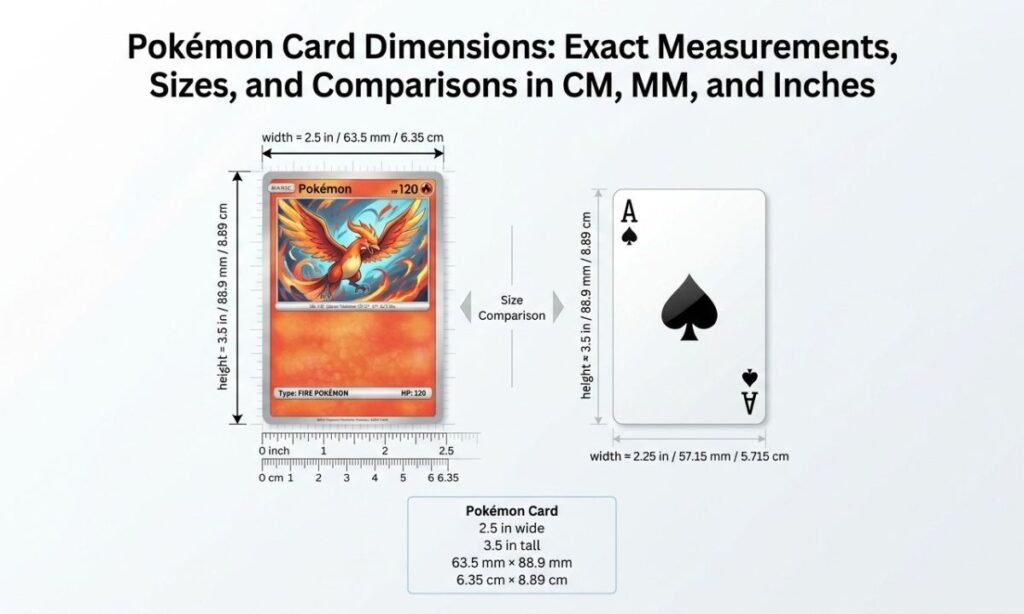
A standard Pokémon card measures 2.5 inches wide by 3.5 inches tall, or 63.5 mm by 88.9 mm. That’s the same footprint used by most trading card games worldwide, which is why a huge range of sleeves, binders, and top loaders are cross-compatible.
It sounds simple, but small variations a millimeter here, a fraction of an inch there can be the difference between a snug-fitting sleeve and a card that slides around and picks up wear.
This guide breaks down every measurement you could need: metric and imperial conversions, pixel dimensions for digital design, real-world size comparisons, sleeve and top loader fit, and how Pokémon card dimensions compare to other trading card games. You’ll also find quick-reference tables throughout so you can find a number fast without re-reading a whole section.
Quick Conversion / Measurement Reference
A standard Pokémon card is 2.5 x 3.5 inches. Here’s how that translates across the units you’re most likely to need.
| UNIT | VALUE |
| Inches | 2.5 x 3.5 in |
| Centimeters | 6.35 x 8.89 cm |
| Millimeters | 63.5 x 88.9 mm |
| Meters | 0.0635 x 0.0889 m |
| Feet | 0.208 x 0.292 ft |
| Thickness | ~0.3 mm (0.012 in) |
Sellers and community forums often round these figures to 63 x 88 mm, which is close enough for everyday reference but not precise enough for grading or manufacturing tolerances.
Quick Reference Table
Here’s how a Pokémon card stacks up against everyday objects you probably already have nearby.
| ITEM | APPROXIMATE LENGTH / SIZE | HOW CLOSE TO POKÉMON CARD |
| Standard playing card | 2.5 x 3.5 in | Exact |
| Credit/debit card | 3.37 x 2.13 in | Close (shorter, wider) |
| Magic: The Gathering card | 2.5 x 3.5 in | Exact |
| Yu-Gi-Oh! card | 2.4 x 3.3 in | Very close |
| US dollar bill | 2.61 x 6.14 in | Close in width only |
| Post-it note (3×3) | 3 x 3 in | Close |
| Smartphone (average) | 2.8 x 5.8 in | Close in width only |
| Index card (3×5) | 3 x 5 in | Close, slightly larger |
What Does a Pokémon Card Look Like in Real Terms?
Picture a standard playing card a Pokémon card is essentially that exact size. It’s small enough to fan out ten in one hand but large enough to clearly show artwork, HP, and attack text without feeling cramped. If you line one up against a credit card, the Pokémon card is noticeably taller but a bit narrower, since credit cards are wider and shorter overall.
A ruler graphic showing a Pokémon card at 63.5mm x 88.9mm next to a credit card and a playing card for scale. Suggested Image Alt Text: “Pokémon card dimensions size comparison with ruler and credit card”
Quick Measurements for Pokémon Cards
Standard Pokémon Card Size at a Glance
Every standard Pokémon TCG card, regardless of set, rarity, or print year, follows the same footprint: 2.5 x 3.5 inches (63.5 x 88.9 mm). This has been true since the game launched in 1996, so a card from a modern set will fit the same sleeve as a card from the very first base set.
Pokémon Card Width and Height
The width the shorter edge is 2.5 inches (63.5 mm). The height, or the longer edge you hold the card upright by, is 3.5 inches (88.9 mm). Getting width and height right matters most when you’re ordering custom sleeves or setting up a print template, since mixing them up will rotate your entire design.
Pokémon Card Thickness and Weight
A single Pokémon card is roughly 0.3 mm thick (about 0.01–0.012 inches), often described in collector terms as “35pt.” Holographic and full-art cards can run slightly thicker, closer to 0.5–0.76 mm, because of the added foil layer. Individually, a card weighs only a few grams light enough that a full 60-card deck still fits comfortably in a small deck box.
Exact Pokémon Card Dimensions: The Complete Breakdown
Related Post: Monster Can Dimensions: 8 oz, 16 oz & 24 oz Size, Height, and Diameter Guide
Standard Pokémon Card Measurements
To summarize the core numbers: 2.5 x 3.5 inches, 63.5 x 88.9 mm, 6.35 x 8.89 cm, roughly 0.3 mm thick. These are the figures used by manufacturers producing official sleeves, toploaders, and binder pages.
Card Shape and Aspect Ratio
A Pokémon card has an aspect ratio of roughly 5:7 (width to height), with gently rounded corners rather than sharp right angles. The rounded-corner radius is small around 3 mm but it’s part of what makes an authentic card feel different from a badly cut counterfeit.
Why Accurate Card Dimensions Matter
Precise Pokémon card dimensions matter for more than trivia. Graders like PSA and BGS measure centering in millimeters, sleeve and top loader manufacturers rely on exact tolerances to avoid cards that are too loose or too tight, and anyone printing proxies or custom art needs the right pixel-to-inch ratio to avoid a blurry or misaligned final product.
Pokémon Card Dimensions in CM, MM, and Inches
Pokémon Card Size in Centimeters
In centimeters, a standard card is 6.35 cm wide by 8.89 cm tall. This is the unit most commonly used by European sleeve and binder manufacturers.
Pokémon Card Size in Millimeters
In millimeters, the card measures 63.5 mm by 88.9 mm. This is the unit graders and precision manufacturers work in, since a single millimeter of variance can affect centering scores or sleeve fit.
Pokémon Card Size in Inches
In inches, it’s 2.5 x 3.5 the easiest figure to remember, since it matches a standard playing card exactly.
Pokémon Card Dimensions in Pixels for Digital Designs
Pokémon Card Dimensions in Pixels by Resolution
At 72 DPI (standard web resolution), a Pokémon card comes out to about 180 x 252 pixels. At 150 DPI, that grows to 375 x 525 pixels. For anything meant to be printed, you’ll want a much higher resolution than either of these.
300 DPI Pokémon Card Size for Printing
At 300 DPI the standard for sharp, print-ready output a Pokémon card measures 750 x 1050 pixels. This is the resolution most professional card printers and proxy services expect.
600 DPI Pokémon Card Size for High-Quality Printing
For extra-crisp printing, particularly for foil or textured finishes, doubling to 600 DPI gives you 1500 x 2100 pixels. This is higher than most projects need, but it leaves room for cropping or upscaling without losing quality.
Print Bleed and Safe Area for Card Designs
Add a bleed margin of about 0.125 inches (roughly 37 pixels at 300 DPI) around all four edges so nothing important gets trimmed during cutting. Your full canvas at 300 DPI, bleed included, becomes about 825 x 1125 pixels.
Pokémon Card Dimensions for Procreate
In Procreate, set your canvas to 750 x 1050 px at 300 DPI for a print-accurate Pokémon card template, or bump it to 825 x 1125 px if you want bleed built in from the start.
Digital Canvas Settings for Pokémon Card Artwork
For pure digital display (no printing), 750 x 1050 px is still a solid default it keeps the correct 2.5:3.5 aspect ratio and displays cleanly on most screens.
All Pokémon Card Sizes: Standard, Jumbo, and Other Variants
Standard Pokémon Card Size
The vast majority of Pokémon cards you’ll encounter commons, holos, full-arts, in every set follow the standard 2.5 x 3.5 inch size.
Jumbo Pokémon Cards
Jumbo promotional cards scale the standard design up dramatically, commonly landing around 5 x 7 inches (126 x 178 mm) or larger. They’re not legal for tournament play and exist mainly as display pieces.
Oversized and Special Pokémon Card Formats
Some special promotional formats go even bigger. Box toppers run around 90 x 126 mm, while extra-large CoroCoro promos have reached roughly 145 x 205 mm.
Promotional and Special-Edition Card Sizes
| VARIANT | APPROXIMATE SIZE |
| Standard card | 63.5 x 88.9 mm |
| Box topper | 90 x 126 mm |
| Jumbo L | 133 x 185 mm |
| Jumbo XL | 145 x 200 mm |
| CoroCoro XXL | 145 x 205 mm |
How Pokémon Card Sizes Differ by Format
Outside of jumbo and promo formats, every standard Pokémon card trainers, energy, Pokémon shares the identical footprint, so a single deck box and sleeve type covers an entire deck.
How Big Is a Pokémon Card? Visual Size Comparisons
Pokémon Card vs. a Standard Credit Card
A credit card (3.37 x 2.125 in) is wider but noticeably shorter than a Pokémon card (2.5 x 3.5 in). Side by side, the Pokémon card looks taller and narrower.
Pokémon Card vs. a US Dollar Bill
A dollar bill (2.61 x 6.14 in) is close in width but far longer roughly 1.75 Pokémon cards laid end to end.
Pokémon Card vs. a Standard Smartphone
An average smartphone is close in width to a Pokémon card but considerably taller, since most phones now measure well over 5.5 inches long.
Pokémon Card vs. a Traditional Playing Card
This is the closest match on the list a standard playing card and a Pokémon card share the same 2.5 x 3.5 inch footprint exactly.
Pokémon Card vs. a Post-It Note
A 3×3 inch Post-it is slightly wider and slightly shorter than a Pokémon card, but close enough that it’s a handy mental reference.
Pokémon Card Size Compared With Common Objects
For a fast mental yardstick: a Pokémon card is basically a playing card, slightly narrower than a credit card, and noticeably shorter than a dollar bill or smartphone.
Japanese vs. International Pokémon Cards: Are They the Same Size?
Japanese Pokémon Card Dimensions
Japanese Pokémon cards are slightly narrower than international cards, commonly cited around 59.9 mm wide, while keeping a similar height.
International Pokémon Card Dimensions
International (English and other Western-language) cards use the standard 63.5 x 88.9 mm size.
Key Differences Between Japanese and International Cards
The height is nearly identical between the two, but the width gap a few millimeters is enough that Japanese-sized sleeves will fit loosely on international cards and vice versa. Always match sleeve type to card origin.
Pokémon Card Dimensions for Sleeves, Binders, and Storage
Related Post: 5 Inches: How Long Is 5 Inches? 13 Everyday Examples to Help You Visualize It
Choosing the Right Sleeve Size for Pokémon Cards
Look for sleeves labeled for “standard size” trading cards, since that matches the 63.5 x 88.9 mm Pokémon card footprint.
Sleeve Sizes by Card Type
| SLEEVE TYPE | APPROXIMATE SIZE |
| Standard outer sleeve | 66 x 91 mm |
| Perfect Fit inner sleeve | 64 x 89 mm |
| Toploader | 67 x 95 mm |
Standard Sleeves vs. Perfect Fit Sleeves
Standard sleeves leave a bit of room for easy insertion, while Perfect Fit sleeves hug the card closely useful when double-sleeving for tournament play.
Pokémon Card Binder Pocket Size
Most 9-pocket binder pages are built around 67 x 93 mm pockets, giving enough clearance for a sleeved card to slide in and out without resistance.
Toploader Size for Pokémon Cards
A standard toploader measures around 67 x 95 mm rigid enough to prevent bending, especially for high-value cards being shipped or graded.
Choosing the Right Storage for Card Protection
For everyday cards, a sleeve and binder pocket is plenty. For valuable or graded cards, stack a Perfect Fit sleeve, a standard sleeve, and a toploader for maximum protection.
Pokémon Cards vs. Other Trading Card Dimensions
Pokémon Cards vs. Yu-Gi-Oh! Cards
Yu-Gi-Oh! cards run slightly smaller, around 2.4 x 3.3 inches, so Yu-Gi-Oh! sleeves will fit a Pokémon card loosely at best.
Pokémon Cards vs. Magic: The Gathering Cards
Magic cards match the Pokémon card footprint almost exactly at 2.5 x 3.5 inches, though corner-radius differences mean Perfect Fit sleeves aren’t always interchangeable.
Pokémon Cards vs. Sports Trading Cards
Sports cards typically also use the 2.5 x 3.5 inch standard, making most sleeves and toploaders cross-compatible with Pokémon cards.
Pokémon Cards vs. Standard Playing Cards
These two are essentially identical in size, which is why Pokémon cards feel instantly familiar to anyone who’s shuffled a deck of playing cards.
How to Spot Fake Pokémon Cards Using Dimensions
Checking Pokémon Card Width and Height
Measure against the known 63.5 x 88.9 mm standard. A card that’s noticeably off in either direction is a red flag.
Comparing Card Proportions and Corners
Check the corner radius authentic cards have a consistent, gentle curve. Bootlegs often have sharper or uneven corners.
Checking Card Thickness and Material
Genuine cards feel close to 0.3 mm thick with a distinct card-stock snap. Fakes are often thinner, flimsier, or oddly glossy.
Comparing a Suspected Card With an Authentic Card
The fastest real-world check is a side-by-side comparison against a card you already know is genuine, using calipers or a precise ruler if possible.
Why Dimensions Alone Cannot Confirm a Fake Card
Dimensions are a strong first filter, but not definitive proof some counterfeits are cut to near-exact size. Combine measurement checks with texture, print quality, and holo-pattern inspection for a full verdict.
Pokémon Card Size for Printing and Custom Card Projects
Setting the Correct Pokémon Card Print Size
For a print-accurate custom card, set your document to 2.5 x 3.5 inches (or 750 x 1050 px at 300 DPI).
Adding Bleed and Trim Margins
Add roughly 0.125 inches of bleed on every edge so trimming doesn’t cut into your design.
Choosing the Right Resolution for Printing
Stick to 300 DPI minimum for crisp text and artwork; go up to 600 DPI if you want extra headroom for foil or texture effects.
Preparing Custom Pokémon Card Designs
Keep important text and artwork at least a few millimeters inside the trim line, and always proof a test print before ordering a full batch.
Pokémon Card Dimensions for Collectors
Why Correct Card Measurements Matter to Collectors
Accurate measurements affect grading, storage compatibility, and resale confidence a card that’s slightly off-size can signal damage or a reprint issue.
Protecting Cards Without Changing Their Shape
Use correctly sized sleeves and toploaders rather than forcing a card into a snug-fitting alternative, which can bend corners or warp edges over time.
Measuring Pokémon Cards Without Damaging Them
Use a soft measuring tape or digital calipers rather than a metal ruler edge, and always measure through a sleeve if the card is graded or especially valuable.
Measuring a Pokémon Card Without a Ruler
Not everyone has a ruler handy, but a few everyday objects make solid stand-ins for estimating a Pokémon card’s size.
| REFERENCE OBJECT | APPROXIMATE SIZE | HOW IT HELPS |
| Standard playing card | 2.5 x 3.5 in | Matches exactly |
| Credit card | 3.37 x 2.13 in | Close for width estimation |
| 3×5 index card | 3 x 5 in | Slightly larger, good rough gauge |
| Smartphone width | ~2.8 in | Close approximation for width |
These comparisons are approximate for anything requiring precision, like buying sleeves in bulk or grading prep, use an actual ruler or calipers.
Pokémon Card Dimensions vs. Similar Measurements
| MEASUREMENT | APPROXIMATE VALUE | DIFFERENCE |
| Yu-Gi-Oh! card | 60 x 86 mm | Smaller |
| Pokémon card | 63.5 x 88.9 mm | Reference point |
| Jumbo Pokémon card | 126 x 178 mm | About double |
Seeing these side by side makes it easier to understand why sleeves and toploaders aren’t always interchangeable between formats, even when the games look similar on the shelf.
Frequently Asked Questions
What are the exact dimensions of a Pokémon card?
A standard Pokémon card measures 2.5 x 3.5 inches, or 63.5 x 88.9 mm.
Are all Pokémon cards the same size?
Yes, all standard cards share this size only jumbo and special promotional cards are larger.
Are Japanese Pokémon cards the same size as English cards?
Not exactly Japanese cards are slightly narrower, around 59.9 mm wide, versus 63.5 mm for international cards.
What size sleeves fit Pokémon cards?
Standard trading card sleeves, roughly 66 x 91 mm, fit Pokémon cards well.
What size toploader fits a Pokémon card?
A standard toploader at about 67 x 95 mm is the typical fit.
What is the best pixel size for printing a Pokémon card?
750 x 1050 pixels at 300 DPI is the standard for sharp, print-ready results.
How thick is a Pokémon card?
About 0.3 mm, or roughly 0.01–0.012 inches.
Do Pokémon cards fit in Magic: The Gathering sleeves?
Generally yes, since both use the same 2.5 x 3.5 inch standard, though corner-radius differences can make Perfect Fit sleeves less exact.
Conclusion
At its core, a Pokémon card is 2.5 x 3.5 inches, or 63.5 x 88.9 mm a size that’s stayed consistent since 1996 and lines up almost exactly with a standard playing card. From there, the details branch out: millimeters for graders, pixels for digital design, and slightly different numbers for jumbo, promotional, and Japanese-market cards.
If you only remember one thing, remember this: hold up a regular playing card, and you’re holding the same footprint as a Pokémon card. Everything else sleeve sizing, toploader fit, print resolution is just that one measurement scaled or converted for a specific job.
