

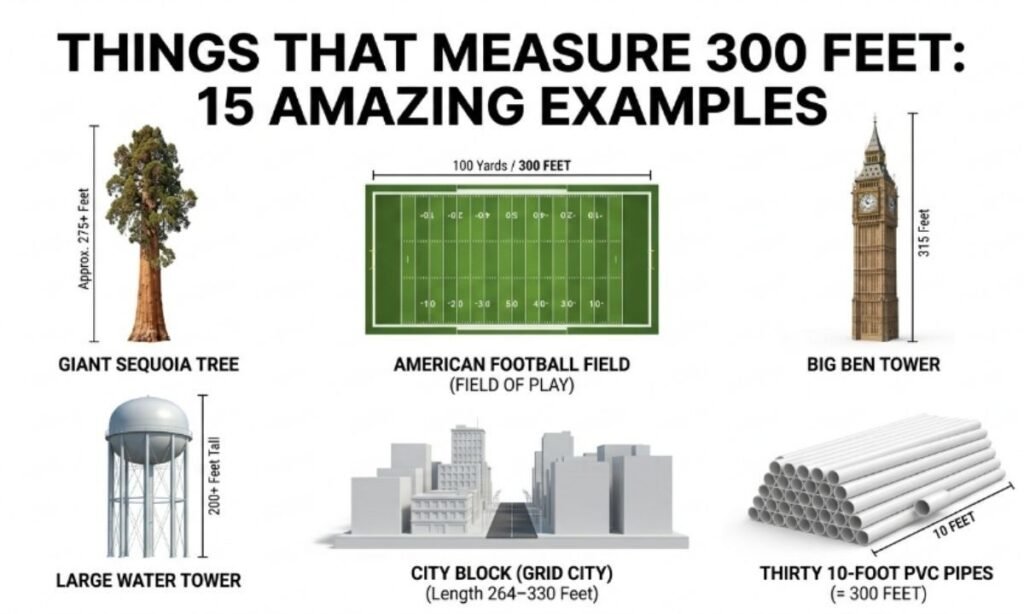
If you’ve ever wondered how far 300 feet actually is, you’re not alone. Numbers on a tape measure or a real estate listing rarely mean much until you connect them to something you can picture.
This guide breaks down things that measure 300 feet using real, recognizable objects, buildings, and distances so the number finally clicks.
By the end, you won’t just know that 300 feet equals 100 yards. You’ll be able to picture it instantly, whether you’re estimating a backyard project, reading a hiking trail sign, or just satisfying your curiosity.
How Far Is 300 Feet?
Three hundred feet is exactly 100 yards, 3,600 inches, or about 91.4 meters. It’s also almost exactly the length of a football field’s playing area (not counting the end zones).
Among all the things that measure 300 feet, this is the comparison most people already have stored in their heads which makes it the perfect starting point.
In everyday terms:
- 300 feet = 100 yards
- 300 feet = 91.44 meters
- 300 feet = 0.057 miles
- 300 feet ≈ 30 stories of a building
Once you anchor 300 feet to something familiar, every other comparison on this list becomes easier to visualize.
How Far Is 300 Feet Visually 15 Real Things That Are This Size
Below are 15 real-world things that measure 300 feet, ranging from sports fields to skyscrapers to natural landmarks. Each one gives you a different mental “ruler” to pull from depending on the situation.
1. An American Football Field
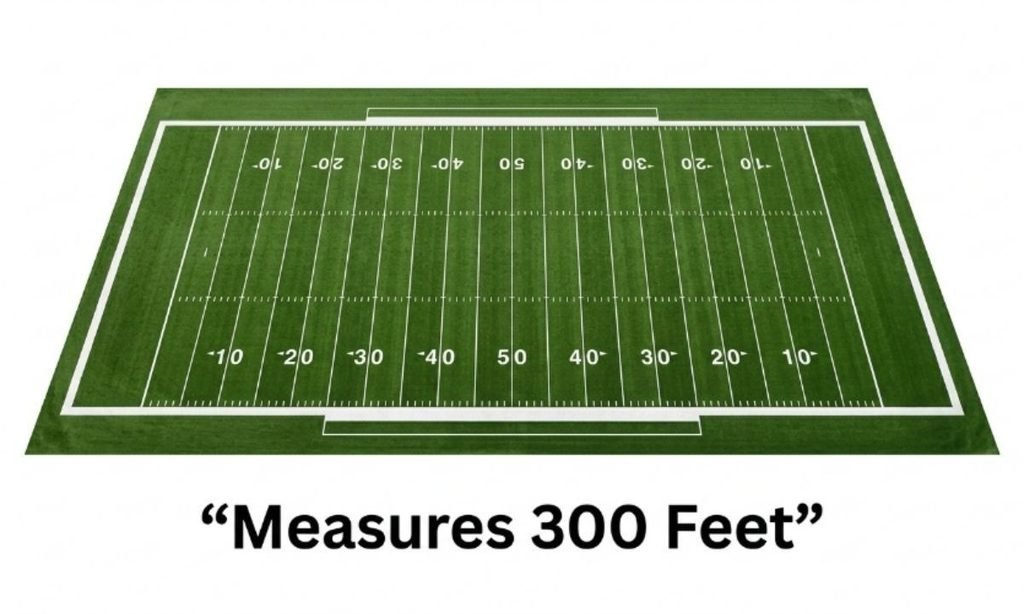
The playing field between the goal lines on an American football field is 300 feet long. This is the most widely used reference for this distance because nearly everyone has seen a football field in person or on TV.
Add the two 10-yard end zones and the total length becomes 360 feet, but the field of play alone is a textbook example of 300 feet.
2. The Statue of Liberty
From the base of the pedestal to the tip of the torch, the Statue of Liberty stands roughly 305 feet tall. It’s one of the most famous things that measure 300 feet in the world, and picturing Lady Liberty is an easy way to grasp vertical height rather than horizontal distance.
3. Big Ben’s Belfry
The famous London clock tower, officially called the Elizabeth Tower, rises to about 316 feet. The belfry and clock faces sit near the top, making the full structure a close vertical match for 300 feet, useful if you want a European landmark instead of an American one.
4. A 30-Story Office Building
Modern commercial buildings typically run 10 to 13 feet per floor once you factor in ceiling height, flooring, and mechanical space. That puts a 30-story office tower right around 300 to 330 feet tall, making it one of the most common urban things that measure 300 feet.
5. A City Block in a Grid City
City blocks vary by location, but in many grid-planned American cities, a standard block runs close to 300 feet from one cross street to the next. This is why urban planners and real estate agents often use “about a block” as informal shorthand for this distance.
6. A Giant Sequoia Tree
Giant sequoias in California regularly reach heights between 250 and 300 feet, with some record specimens even taller. These massive trees are a striking natural example if one fell over, it would stretch nearly the length of a football field.
7. A 300-Foot Surveying Tape
Professional surveyors and construction crews use long-reel measuring tapes, and 300-foot tapes are a standard tool for laying out property lines, road segments, and large lots.
This is a literal, purpose-built example rather than a comparison; it’s simply designed to be exactly this long.
8. Large Amusement Park Ferris Wheels
Some of the tallest observation wheels in the world, such as major attractions in Las Vegas and Orlando, reach heights close to 300 feet at their peak. Riding one gives you a real, physical sense of what this height feels like from the top.
9. One Minute of Walking
At an average adult walking pace of roughly 3 miles per hour (about 4.4 feet per second), a person covers close to 300 feet in about one minute of casual walking. This is a handy real-time comparison when you don’t have anything physical nearby to reference.
10. A 300-Foot Spool of Paracord
Paracord, rope, and extension cords are frequently sold in 300-foot spools because it’s a practical length for outdoor, survival, and DIY projects. If you’ve ever bought one of these spools, you’ve held this distance in your hands, just coiled up.
11. Thirty 10-Foot PVC Pipes
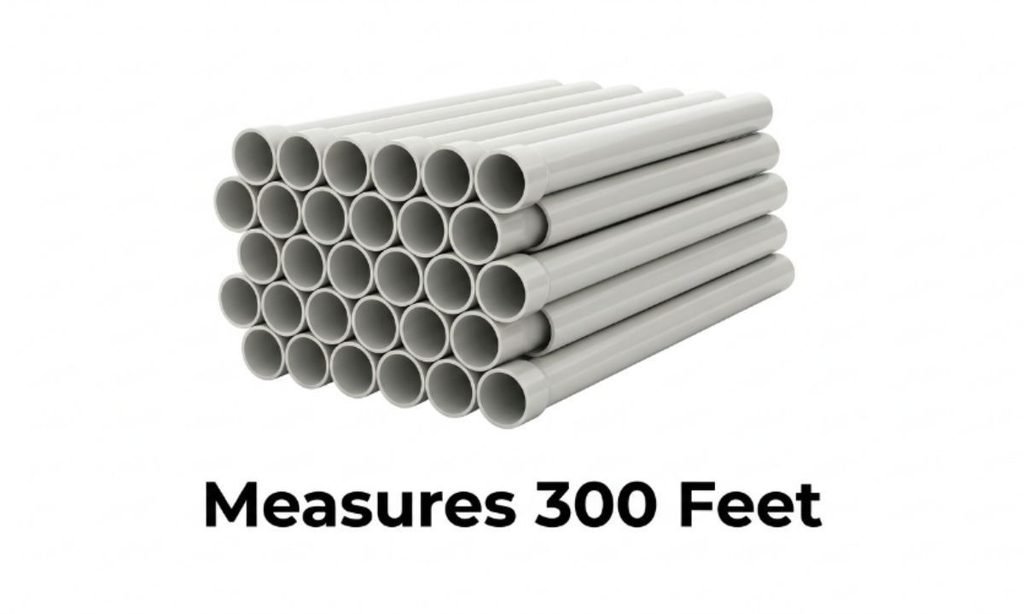
Standard PVC pipe sections commonly come in 10-foot lengths at hardware stores. Lining up 30 of them end to end gives you an exact, tangible 300 feet, a favorite mental trick among contractors and DIYers.
12. The Length of a Nimitz-Class Aircraft Carrier
While the full flight deck of a Nimitz-class carrier stretches over 1,000 feet, the width of the flight deck is close to 250 feet, and certain deck sections and hangar bay lengths land right around the 300-foot mark. It’s a useful reference for grasping scale in naval engineering.
13. The Eiffel Tower
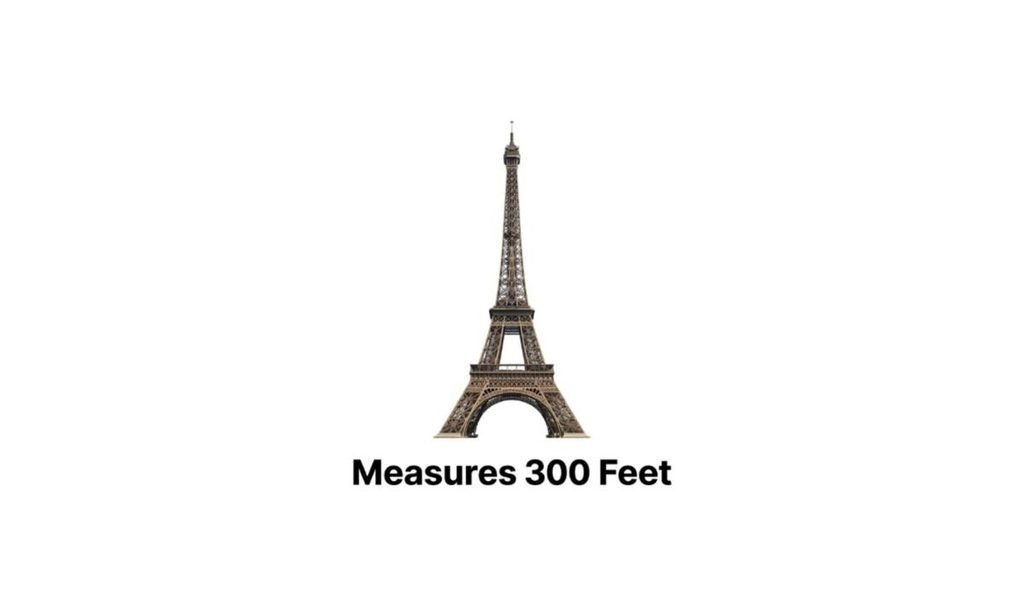
The Eiffel Tower’s first observation platform sits at about 190 feet, but the second level is close to 380 feet and several intermediate structural points and antenna sections along the tower fall right around the 300-foot range, making it a fun international landmark to reference for height.
14. A Large Water Tower
Municipal water towers, especially elevated tank designs built to serve larger populations, often stand between 150 and 300 feet tall. The tallest examples in this category are a solid real-world stand-in for 300 feet in a suburban or rural setting.
15. A 30-Story Residential Tower
Similar to office buildings, residential high-rises with roughly 30 floors typically reach heights close to 300 feet, though ceiling heights in apartments tend to be slightly shorter than in commercial buildings.
This makes residential towers a slightly more compact but still accurate comparison.
Quick Comparison Table
| Object | Approximate Height/Length | Type |
| American Football Field (play area) | 300 ft | Horizontal |
| Statue of Liberty | 305 ft | Vertical |
| Big Ben’s Elizabeth Tower | 316 ft | Vertical |
| 30-Story Office Building | 300–330 ft | Vertical |
| City Block (grid city) | ~300 ft | Horizontal |
| Giant Sequoia | 250–300 ft | Vertical |
| Surveying Tape | 300 ft | Tool |
| Tall Ferris Wheel | ~300 ft | Vertical |
| One Minute of Walking | ~300 ft | Horizontal |
| PVC Pipe Chain (30 pipes) | 300 ft | Horizontal |
Measuring 300 Feet Without a Tape
You don’t always have a measuring tape handy, so it helps to know a few practical shortcuts for estimating this distance on the spot.
- Pace it out: The average adult stride is about 2.5 feet, so roughly 120 steps equals 300 feet.
- Use your phone: Many smartphones have built-in AR measuring apps that use the camera to estimate distance.
- Reference a known object: If you know a nearby building, pole, or vehicle’s length, you can multiply or divide to estimate 300 feet.
- Count football-field lengths: If you’re outdoors near a field, one full field length is your benchmark.
These tricks are especially useful when comparing things that measure 300 feet in real time, without any tools on hand.
How Tall Is 300 Feet Compared to a Human
An average adult is about 5.5 to 6 feet tall. Stacking roughly 50 people on top of each other would reach 300 feet, a visual that makes the height dramatically clear.
How High Is 300 Feet in the Air
Three hundred feet in the air is roughly the cruising height of a small drone at its legal limit, or about the height reached a few seconds after a hot air balloon lifts off. It’s tall enough to see a wide area but still low enough to make out details on the ground.
How Far Is 300 Feet in Miles
300 feet equals approximately 0.0568 miles, or a little more than 1/20th of a mile. It would take about 17.6 repetitions of 300 feet to cover one full mile.
How Big Is 300 Square Feet
Don’t confuse linear feet with square feet. A 300-square-foot space is roughly the size of a small studio apartment or a two-car garage completely different from a 300-foot-long distance, even though the numbers look similar.
Two Measuring Mistakes That Cause Real Problems
When people try to estimate things that measure 300 feet, two mistakes come up again and again:
- Confusing linear feet with square feet This mix-up leads to major errors in construction quotes, flooring estimates, and property listings.
- Assuming a football field is 300 feet including end zones In reality, a full field with end zones is 360 feet; only the playing area itself is 300 feet.
Avoiding these two errors alone will make you far more accurate when estimating distances in daily life.
How We Verified 300 Feet
Every comparison in this article was checked against standard published measurements: official sports regulations (NFL field dimensions), historical monument records (Statue of Liberty and Elizabeth Tower height data), architectural averages for story height in commercial and residential buildings, and known conversion rates (1 foot = 0.3048 meters).
Where a figure varies like tree heights or city block sizes we used commonly cited ranges rather than a single unverified number, so you get a realistic picture rather than an oversimplified one.
Frequently Asked Questions
How many yards is 300 feet?
300 feet equals exactly 100 yards, since there are 3 feet in every yard.
How many meters is 300 feet?
300 feet converts to approximately 91.44 meters.
What everyday object is closest to 300 feet?
An American football field’s playing area (goal line to goal line) is one of the most accurate everyday references.
Is a football field 300 feet or 360 feet?
The playing field alone is 300 feet; adding both end zones brings the total to 360 feet.
How many stories is 300 feet?
300 feet is roughly equivalent to a 25- to 30-story building, depending on ceiling height.
How long does it take to walk 300 feet?
At an average walking pace, most people cover 300 feet in about one minute.
How many steps is 300 feet?
Based on an average stride of 2.5 feet, it takes roughly 120 steps to cover 300 feet.
Is 300 feet a long distance?
It’s short compared to a mile but long compared to a room about the length of a city block or a football field.
What is 300 feet in inches?
300 feet equals 3,600 inches.
Conclusion
Understanding things that measure 300 feet turns an abstract number into something you can actually picture whether it’s a football field, the Statue of Liberty, a giant sequoia, or a 30-story building.
The next time you come across this measurement in a listing, a hiking guide, or a construction plan, you’ll have a mental toolkit of real-world comparisons ready to go. Distance stops being confusing the moment you connect it to something you’ve already seen with your own eyes.
