

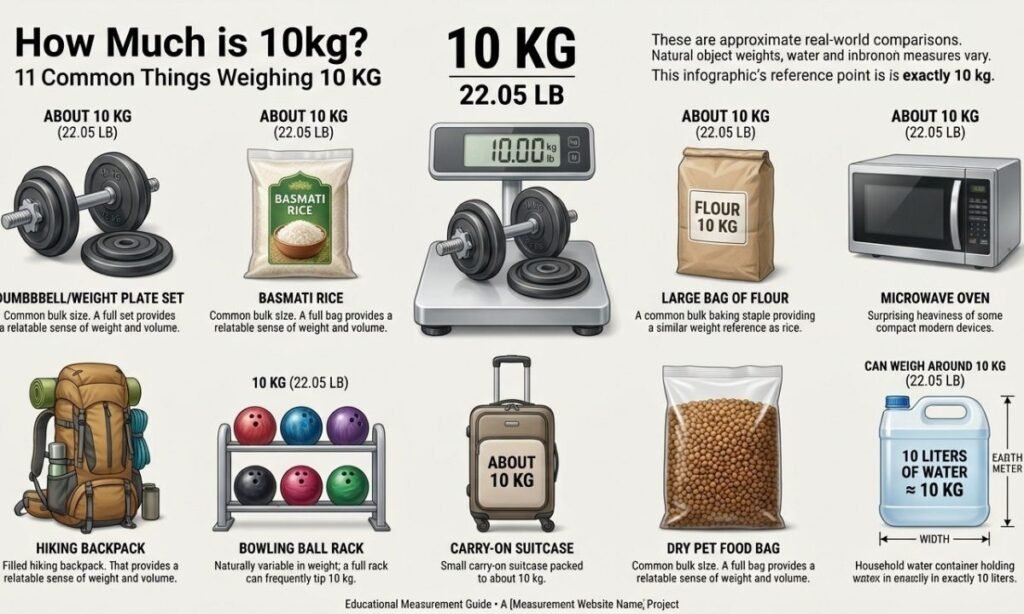
Ever picked something up and wondered just how heavy it really is compared to everyday objects? If you’ve asked yourself “how much is 10kg,” you’re not alone it’s one of the most searched weight comparisons because 10 kilograms sits right in that everyday range:
heavy enough to notice, light enough to carry short distances without much strain In simple terms, 10kg is a measurement of mass equal to 10,000 grams, roughly 22 pounds, or about the weight of a medium-sized dog. It’s a number you’ll run into constantly on shipping labels, gym equipment,
luggage limits, and grocery bags which makes it worth understanding in real, tangible terms rather than just as an abstract figure. This article breaks down exactly how much 10kg is through conversions, comparison tables, and 11 familiar objects that weigh close to that amount. By the end, you’ll be able to picture 10kg instantly,
How Much Is 10kg? A Quick Overview
Before diving into comparisons, it helps to see 10kg broken down into the units people use most often. The table below converts 10 kilograms into other common weight measurements.
| Unit | Value |
| Kilograms | 10 kg |
| Grams | 10,000 g |
| Pounds | ≈ 22.05 lb |
| Ounces | ≈ 352.7 oz |
| Stone | ≈ 1.57 stone |
So when someone asks “how much is 10kg,” the simplest answer is: about 22 pounds, or the weight of a fairly large bag of rice, a medium dog, or a stack of four bricks. It’s a weight most adults can lift without difficulty, though carrying it for a long distance will start to feel noticeable.
How Much Does 10kg Weigh in Pounds?
10kg converts to approximately 22.05 pounds. This is one of the most searched conversions because pounds are the standard weight unit in the US, while kilograms are used almost everywhere else, including for luggage limits, gym weights, and packaged goods. If you remember that 1 kilogram is roughly 2.2 pounds, you can quickly estimate that 10kg lands just above 22 lb.
How Heavy Is 10kg?
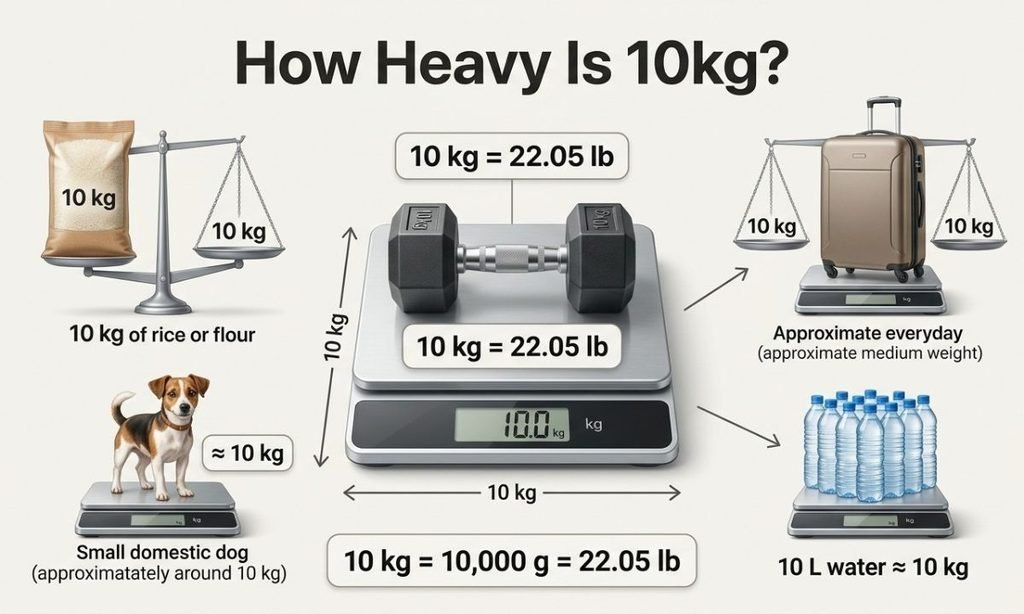
On its own, “10 kilograms” doesn’t mean much until you compare it to something familiar. In practical terms, 10kg is:
- Heavier than a gallon of milk (about 3.9kg)
- Lighter than an average adult’s carry-on suitcase limit (often 10–12kg)
- Roughly equal to a medium-sized dog or a large bag of potatoes
- About the same as two standard bowling balls
It’s a weight that sits comfortably between “light” and “genuinely heavy” easy to lift for a moment, but tiring to carry for an extended period.
How Heavy Is 10kg Compared to Everyday Objects?
Compared to things you’d find around the house, 10kg is close to a full watermelon, a stacked pile of four bricks, or a 24-pack of soda cans. It’s also similar to the weight limit many airlines set for cabin baggage, which is why 10kg is such a commonly referenced number when people pack for a trip.
How Much Does a 10kg Object Feel Like to Carry?
Carrying 10kg feels similar to holding two full 2-liter soda bottles in each hand, or lugging a well-packed school backpack. Most people can carry it comfortably for short distances, like from a car to a front door, but it becomes tiring over a longer walk, which is why 10kg is often treated as a practical upper limit for single-bag carrying.
Can an Average Person Easily Lift 10kg?
Yes. For most healthy adults, lifting 10kg is not physically demanding it’s roughly the weight of a large bag of flour or a medium dog. However, comfort depends on grip, distance, and posture; lifting 10kg with proper form (bending the knees, keeping the object close to the body) is much easier than lifting it awkwardly at arm’s length.
Common Things That Weigh Around 10kg
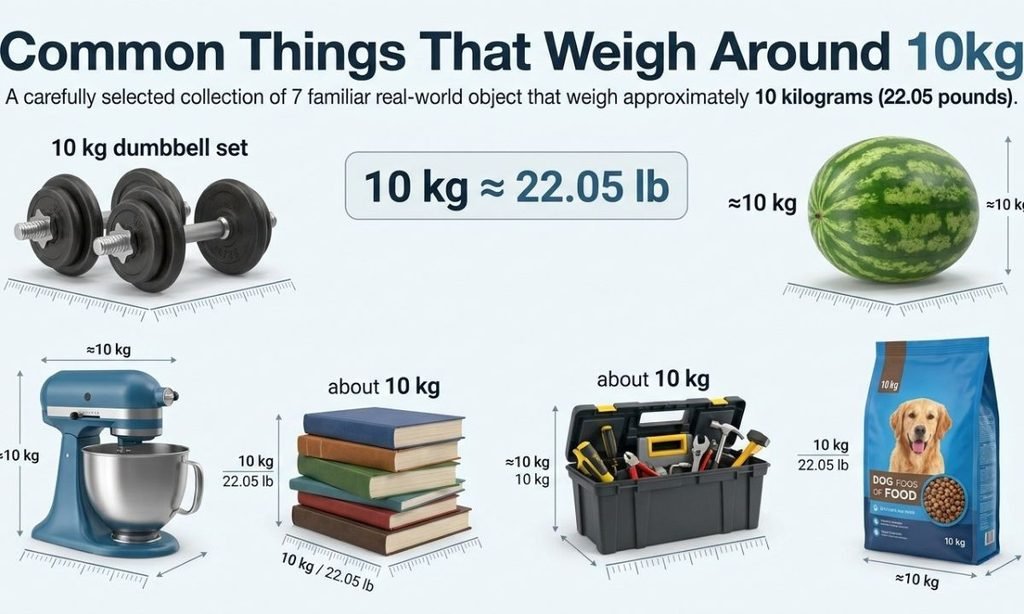
To really understand 10kg, it helps to look at specific, familiar objects that land close to this weight. Below are common things that weigh around 10kg.
Bag of Dog Food
A standard large bag of dry dog food often weighs close to 10kg (22 lb), making it one of the most relatable everyday comparisons. If you’ve ever hauled a bag of dog food from the car to the pantry, you already know what 10kg feels like in your arms.
Two Gallons of Paint
A single gallon of paint weighs roughly 4.5–5kg depending on the type, so two gallons together land right around 9–10kg. This is a useful comparison for anyone planning a home renovation and trying to gauge how much weight they’ll be carrying up a ladder or across a room.
A French Bulldog
Adult French Bulldogs typically weigh between 8kg and 13kg, with many landing close to 10kg. If you’ve ever picked up a French Bulldog, that snug, solid weight in your arms is a great real-world reference for 10kg.
A Medium-Sized Suitcase
A medium suitcase packed for a short trip clothes, shoes, toiletries often weighs close to 10kg. This is also why 10kg is a common cabin-baggage weight limit for many airlines, making it one of the most practically useful comparisons on this list.
A Car Tire
A standard passenger car tire (without the rim) typically weighs between 9kg and 11kg. Mechanics and drivers who’ve changed a tire know this weight well it’s substantial enough to require both hands but manageable to lift and roll.
24-Pack of Soda Cans
A 24-pack of standard soda cans weighs close to 9kg when full, putting it right in the 10kg range. This is a handy mental reference since most people have carried a case of drinks from a store to a car at some point.
A Big Watermelon
Large watermelons commonly weigh between 8kg and 12kg, with many falling right around the 10kg mark. Picking up a big watermelon at the grocery store is one of the more intuitive ways to feel what 10kg is like.
A 10kg Dumbbell
This one is exact by definition. A 10kg dumbbell is a standard weight found in most gyms, and it’s often the benchmark lifters use to gauge strength progress. If you want to know precisely what 10kg feels like, a 10kg dumbbell is the most direct way to experience it.
Four Bricks
A standard clay brick weighs approximately 2.3–2.5kg, so four bricks stacked together weigh close to 10kg. This is a useful comparison for anyone in construction or DIY projects trying to estimate material weight.
Two Bowling Balls
Bowling balls typically range from 5kg to 7kg (11–16 lb) depending on the size chosen. Two average-weight bowling balls together land close to 10kg, making this a relatable comparison for anyone who’s carried a bowling bag.
A School Backpack
A fully loaded school backpack textbooks, laptop, water bottle, supplies can easily reach 8–10kg, especially for older students. Health experts often flag this weight range as a concern for posture, which is part of why backpack weight limits are frequently discussed.
10kg Weight Comparison With Everyday Objects
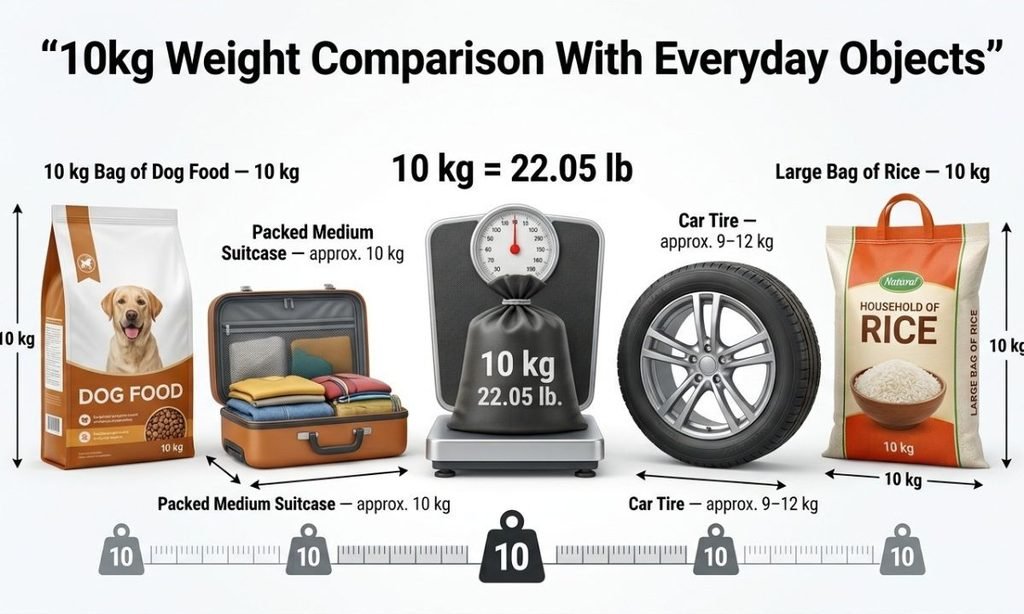
Seeing 10kg next to nearby measurements makes it easier to understand exactly where it sits on the weight scale.
| Measurement | Approximate Value | Difference |
| 5kg | ≈ 11 lb | Half of 10kg |
| 10kg | ≈ 22 lb | Reference point |
| 20kg | ≈ 44 lb | Double 10kg |
As the table shows, 10kg sits at a clear midpoint heavy enough to be a genuine workout weight, but light enough to remain a practical, everyday carrying weight.
10kg Compared to 100 Pounds
100 pounds is roughly 45.4kg, more than four times heavier than 10kg. If 10kg feels like carrying a bag of dog food, 100 pounds feels like carrying an adult human a dramatic jump in effort and difficulty.
10kg Compared to 20 Pounds
20 pounds is about 9.07kg, just slightly under 10kg. These two weights feel almost identical when lifted, making 20 lb one of the closest imperial comparisons to 10kg.
10kg Compared to 22 Pounds
22 pounds is extremely close to 10kg (10kg ≈ 22.05 lb), essentially making them equivalent for practical purposes. This is why 22 lb is the number most commonly cited when converting 10kg into pounds.
Common Household Items Near 10kg
Beyond the items already covered, other household objects near 10kg include a small microwave, a full laundry basket of clothes, a large stand mixer, or a five-gallon bucket filled about halfway with water.
How to Estimate 10kg Without a Scale
You don’t need a scale to get a reasonable sense of 10kg. Practical estimation methods include:
- Picking up a bag of dog food or flour labeled around 22 lb
- Lifting a medium dog you know the weight of
- Comparing it to a 24-pack of canned drinks
- Using a 10kg gym dumbbell as a mental reference point
These comparisons won’t give you an exact number, but they’ll get you close enough for everyday estimation.
Conclusion
At its core, 10kg equals about 22 pounds, or 10,000 grams a weight most people can picture through everyday items like a bag of dog food, a medium suitcase, a large watermelon, or a French Bulldog. It’s heavy enough to require real effort over distance, yet light enough that most healthy adults can lift and carry it without strain.
The easiest way to internalize 10kg is to connect it to something you’ve personally handled a case of soda, a packed carry-on, or a standard gym dumbbell. Once you have that mental anchor, judging other weights in relation to 10kg becomes far more intuitive.
Frequently Asked Questions
What household item weighs exactly 10kg?
A 10kg gym dumbbell is one of the few household items that weighs exactly 10kg, since it’s manufactured to that precise standard.
Is 10kg heavy to carry?
10kg is moderately heavy manageable for short distances but tiring if carried for an extended walk or up several flights of stairs.
How many pounds is 10kg?
10kg equals approximately 22.05 pounds, often rounded to 22 lb for everyday use.
What animal weighs about 10kg?
An adult French Bulldog or a medium-sized dog breed typically weighs close to 10kg.
Is a 10kg suitcase considered heavy for travel?
A 10kg suitcase is on the heavier end for cabin baggage, which is why many airlines set their carry-on weight limit right around this figure.
How much does 10kg feel like when lifted?
It feels similar to lifting a large bag of dog food or two gallons of paint — noticeable but not difficult for most adults.
Can a child lift 10kg?
Some older children and teenagers can lift 10kg briefly, but it’s generally considered too heavy for young children to carry regularly, especially in backpacks.
What’s a good visual comparison for 10kg?
A big watermelon, a 24-pack of soda cans, or four standard bricks are all reliable visual and physical comparisons for 10kg.
