

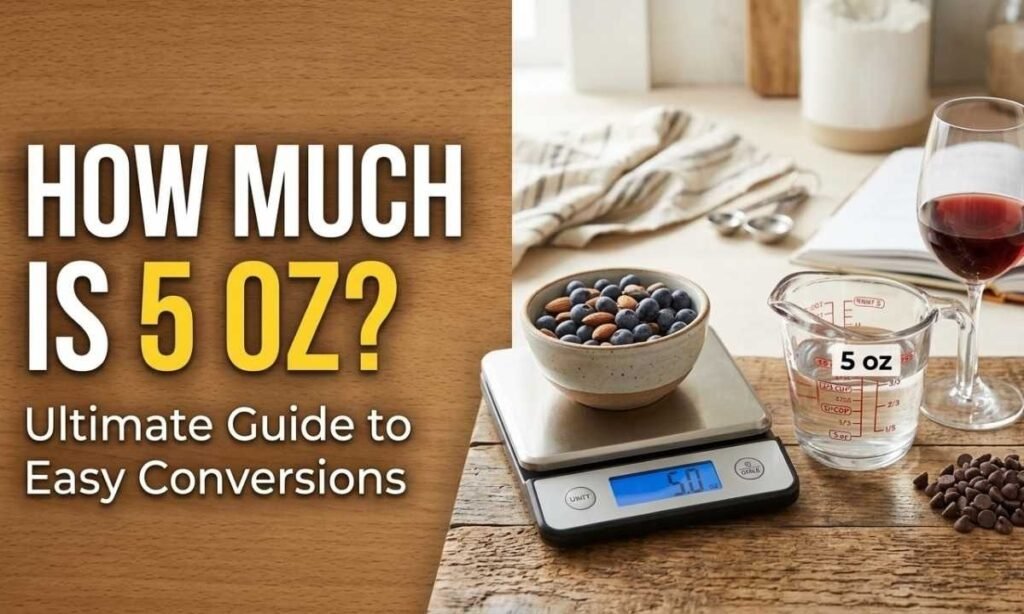
How much is 5 oz? By weight, 5 ounces equals about 141.7 grams, or 0.3125 pounds. By volume, 5 fluid ounces equals about 147.9 milliliters, or five eighths of a US cup.
That two-part answer is why the question trips people up. The word “ounce” covers both weight and volume, and the two are not the same thing. A recipe, a shipping label, and a drink menu can all say “5 oz” and mean different things.
This guide clears it up and shows how much is 5 oz in every unit that matters. You will find a conversion chart, easy ways to measure without a scale, 20 everyday objects that weigh close to 5 ounces, and clear answers to the most common questions.
5 Ounces Converted Into Every Measurement Unit You Need
If you remember only one thing about how much is 5 oz, remember 142 grams for weight and 148 milliliters for liquid. Now for the full chart.
These figures use the US avoirdupois ounce, which is the standard for weight in the United States. One ounce equals 28.3495 grams.
| Unit | 5 Ounces (Weight) Equals |
| Grams | 141.75 g |
| Kilograms | 0.1417 kg |
| Pounds | 0.3125 lb |
| Milligrams | 141,747 mg |
| Stones | 0.0223 st |
Liquids use a different unit, the fluid ounce. Here is how 5 US fluid ounces converts.
| Unit | 5 US Fluid Ounces Equals |
| Milliliters | 147.87 ml |
| Liters | 0.148 L |
| US cups | 0.625 cup (5/8 cup) |
| Tablespoons | 10 tbsp |
| Teaspoons | 30 tsp |
| UK (imperial) fluid ounces | 5.2 imp fl oz |
A simple memory trick: 5 ounces is five sixteenths of a pound. Round it to 142 grams for quick kitchen math, or to 150 milliliters for a liquid.
How to Measure 5 oz at Home Without Using a Scale
You do not always have a scale nearby. Knowing how much is 5 oz is helpful, but you also need a way to check it. A few household tricks get you close.
Use US quarters. A quarter weighs 5.67 grams. Twenty-five of them weigh 141.75 grams, which is almost exactly 5 ounces. It is the cleanest scale-free trick there is.
Use a measuring cup for liquids. Fill the cup to the 5/8 mark. That is half a cup plus two tablespoons, or 10 tablespoons in total.
Use a stick of butter. A US stick is 4 ounces. Add 2 tablespoons from a second stick, since each tablespoon weighs half an ounce. You now have 5 ounces.
Use a baseball. An official baseball weighs 5 to 5.25 ounces. Hold one in your palm, and you know the feel of the weight.
Use a sealed can. Many small tuna cans hold 5 ounces of food. Check the label to confirm.
A few more tips help:
- Always weigh on a flat, stable surface if you can.
- Treat these tricks as estimates, not lab results.
- For baking and portion control, a digital scale is still the best option.
- Use these checks whenever you need to confirm how much is 5 oz on the spot.
20 Everyday Objects That Weigh Approximately 5 Ounces
These objects show how much is 5 oz in everyday life. Weights vary with size, brand, and ripeness, so each entry gives a realistic range you can judge for yourself.
1. A Large Lemon
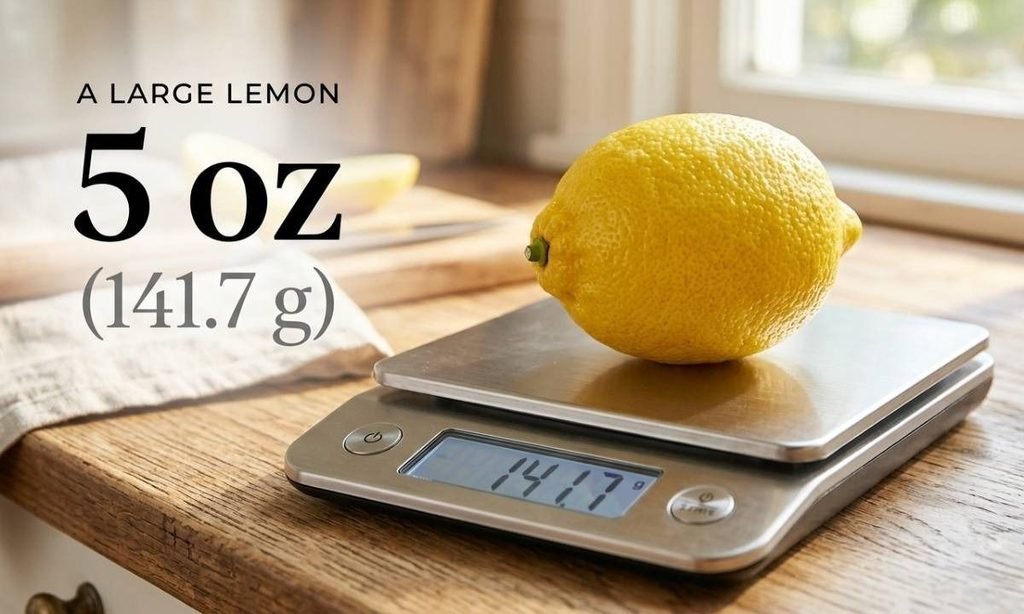
A large lemon weighs about 4 to 5 ounces. Medium ones run closer to 3.5. Lift one in your hand to get a feel for the weight.
2. A Standard Lacrosse Ball
A regulation lacrosse ball weighs between 5 and 5.25 ounces. It is solid rubber, so it feels heavier than its size suggests.
3. A Single D-Cell Battery
An alkaline D battery weighs roughly 5 to 5.5 ounces. It is the heaviest common battery size. One in your hand is a quick weight reference.
4. Three Golf Balls in a Sleeve
A golf ball can weigh no more than 1.62 ounces. Three of them come to about 4.86 ounces. That puts a sleeve of balls right at the mark.
5. A Medium-to-Large Tomato
A medium-to-large tomato often weighs 5 to 6 ounces. Smaller ones fall below that. A kitchen scale gives you an exact figure, but your hand will get close.
6. A Typical TV Remote Control
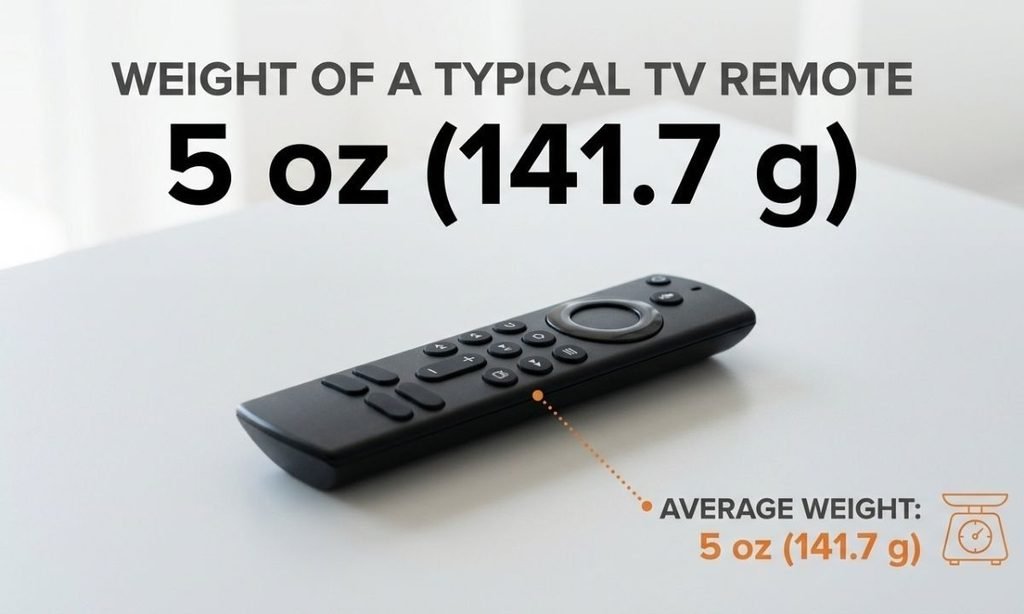
Most TV remotes weigh between 3 and 6 ounces with batteries. A standard one with two AAA cells often lands near 4 to 5 ounces. Bulky smart remotes weigh more.
7. A Large Banana
The edible part of a large banana weighs about 5 ounces once peeled. With the peel on, it weighs closer to 7 or 8 ounces. Keep that in mind when you track portions.
8. A Medium-Sized Onion
A medium onion usually weighs 4 to 5.5 ounces. Large ones can reach 8 ounces or more. Peeling removes a little weight.
9. Three Large Eggs
Out of the shell, three large eggs weigh about 5.3 ounces in total. In the shell, they weigh around 6 ounces. This example works well in recipes that list eggs by weight.
10. A Chocolate Bar Weighing 5 Ounces
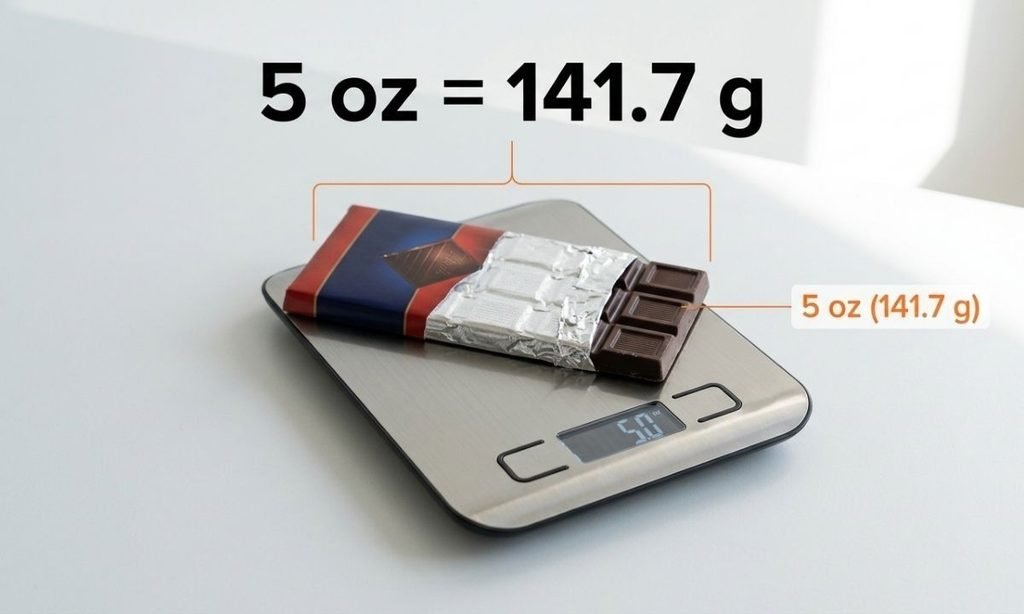
Many brands sell 5-ounce chocolate bars, and the weight is printed on the wrapper. The label tells you the net weight, so you do not need to guess. It feels slightly heavier than a standard candy bar.
11. A Small Pear
A small pear weighs about 5 to 6 ounces. It is a good fruit example because the size is easy to spot. Larger varieties like Bosc go well beyond that.
12. Six AA Batteries
An alkaline AA battery weighs about 0.82 ounces. Six of them add up to roughly 4.9 ounces. A full pack makes a tidy reference.
13. A Medium-Sized Padlock
Padlocks vary widely, but a typical medium laminated lock weighs between 4 and 8 ounces. Small brass locks come closest to 5 ounces. Check the packaging for the listed weight.
14. A Small Handheld Stapler
A compact stapler weighs about 4 to 6 ounces. Heavy-duty desktop models are much heavier. The small travel version is the one that matches.
15. A Five-Fluid-Ounce Glass of Wine
A standard wine pour is 5 fluid ounces, which is about 148 milliliters. Remember that this is volume, not weight. The wine itself weighs around 5.2 ounces.
16. A 5-Ounce Bottle of Cologne
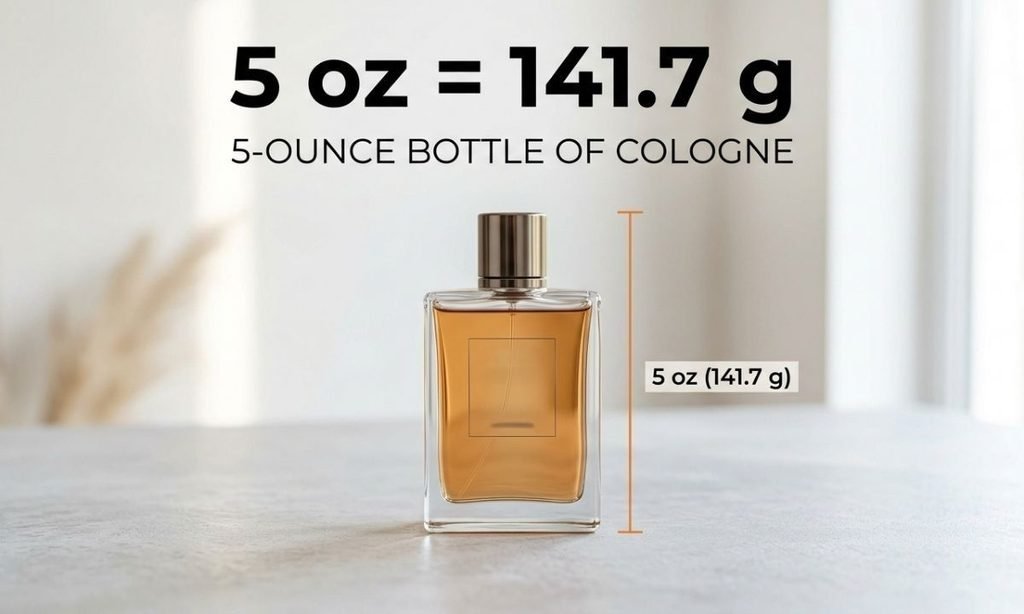
Cologne is sold by fluid ounce, so a 5-ounce bottle holds about 148 milliliters of liquid. The glass and cap add extra weight. Note that this size is too large for a carry-on under the usual 3.4-ounce rule.
17. A Small Can of Tuna
The standard small can of tuna has a net weight of 5 ounces. The drained fish weighs a bit less, often near 4 ounces. It is one of the most common 5-ounce items in any kitchen.
18. A Small Portion of Cooked Chicken Breast
A cooked portion of 5 ounces is about the size of a medium palm. It comes from roughly 6.5 to 7 ounces of raw chicken, since meat loses water as it cooks. This is a popular serving for meal prep.
19. A Baseball
An official baseball weighs between 5 and 5.25 ounces. It is one of the best round weight references you can hold. If you have one at home, you already own a 5-ounce weight.
20. A Small Handful of Nuts
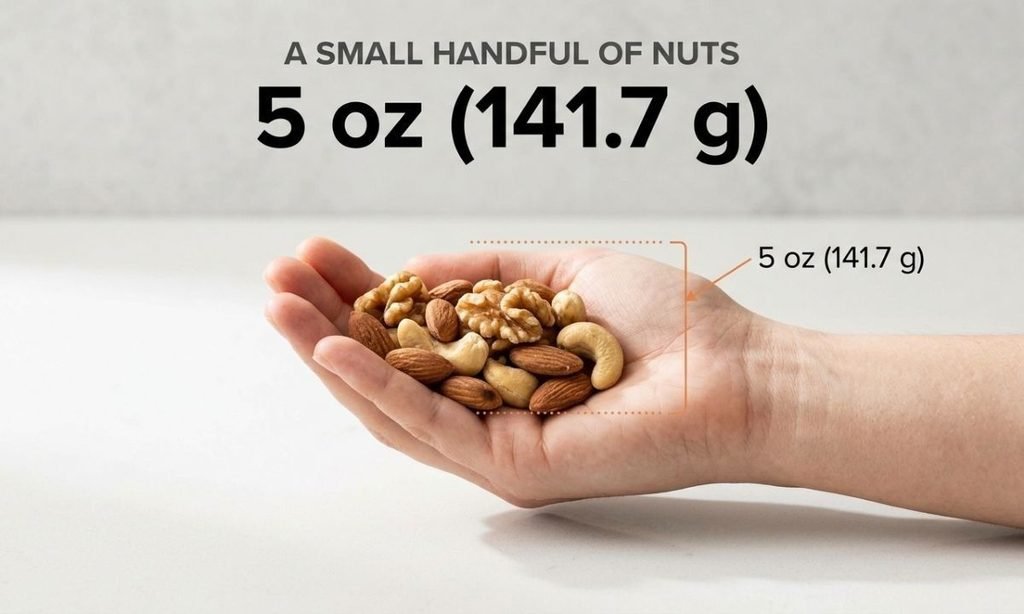
A small handful of nuts weighs about 1 ounce, so 5 ounces is roughly five handfuls. In cup terms, 5 ounces of whole almonds fills a little under one cup. This helps when a recipe lists nuts by weight.
Understanding the Difference Between Ounces and Fluid Ounces
This is the part that causes the most mistakes. An ounce measures weight. A fluid ounce measures volume, or the space a liquid takes up.
They share a name but are not interchangeable. Mixing them up is the top reason people get the wrong answer to how much is 5 oz.
| Feature | Ounce (oz) | Fluid Ounce (fl oz) |
| What it measures | Weight (mass) | Volume (space) |
| Used for | Solids, meat, produce, mail | Drinks, oils, sauces |
| Metric equivalent | 28.35 grams | 29.57 milliliters |
| Tool | Scale | Measuring cup |
Water is the one case where they come close. A fluid ounce of water weighs about 1.04 ounces. So 5 fluid ounces of water weighs around 5.2 ounces.
Other liquids differ more. Honey is heavy, so 5 fluid ounces of honey weighs about 7.5 ounces. Oil is lighter than water, so 5 fluid ounces of oil weighs a little under 5 ounces.
Here is a simple rule:
- If a recipe calls for a liquid, it usually means fluid ounces.
- If it calls for a solid like flour, meat, or cheese, it means ounces by weight.
- If you are unsure, check whether the product label lists “net wt” or “fl oz”.
How Much Is 5 oz in Grams, Pounds, and Kilograms?
When you ask how much is 5 oz in grams, the answer is 141.75 grams. Most people round it to 142 grams.Here is the math, so you can do it yourself:
- To grams: multiply ounces by 28.3495. So 5 × 28.3495 gives 141.75 grams.
- To pounds: divide ounces by 16. So 5 ÷ 16 gives 0.3125 pounds.
- To kilograms: divide grams by 1,000. So 141.75 ÷ 1,000 gives 0.1417 kilograms.
So how much is 5 oz in pounds? Just under a third of a pound. A pound has 16 ounces, so 5 ounces is a little less than one third of that. In pounds and ounces, it stays as 0 pounds, 5 ounces.
For shipping, this is lightweight. Most postal services treat anything under 8 ounces as a light parcel. For cooking, 142 grams is a tidy portion for a single serving of protein.
How Many Milliliters Are in 5 Fluid Ounces?
There are 147.87 milliliters in 5 US fluid ounces. Most people round to 148 or even 150 milliliters.
So how much is 5 oz of liquid in metric? About 148 milliliters. The formula is simple. Multiply fluid ounces by 29.5735. So 5 × 29.5735 gives 147.87.
Be careful with the UK version. A British fluid ounce is slightly smaller, at 28.41 milliliters. So 5 UK fluid ounces equals about 142 milliliters.
That is a gap of nearly 6 milliliters. For drinks, it hardly matters. For a medicine dose or a precise recipe, use the right unit.
How Many Cups, Tablespoons, and Teaspoons Make Up 5 Fluid Ounces?
Cooks often ask how much is 5 oz in cups, and the answer depends on the ingredient. For liquids, five US fluid ounces equals 0.625 cups. That is five eighths of a cup.
Here is how to read it on a measuring cup:
- Cups: 5/8 cup, which is half a cup plus 2 tablespoons
- Tablespoons: 10 tablespoons
- Teaspoons: 30 teaspoons
The math is easy to follow. One cup holds 8 fluid ounces, so 5 ÷ 8 = 0.625. One fluid ounce holds 2 tablespoons, so 5 × 2 = 10. One tablespoon holds 3 teaspoons, so 10 × 3 = 30.
Dry ingredients are different. Because 5 ounces is a weight, the cup measure depends on the ingredient.
| Ingredient (5 oz by weight) | Approximate Volume |
| All-purpose flour | About 1 cup plus 3 tablespoons |
| Granulated sugar | A little under 3/4 cup |
| Butter | 1 stick plus 2 tablespoons |
| Water | About 5/8 cup |
| Honey | About 0.4 cup |
| Whole almonds | A little under 1 cup |
These are estimates. Brands, packing, and humidity all change the result, so weigh when accuracy counts.
What Does 5 Ounces Look Like Compared With Common Household Items?
Pictures make numbers stick, and a familiar object shows how much is 5 oz better than a number can. This table lines up 5 ounces with items you already know.
| Item | Approximate Weight | Compared With 5 oz |
| US nickel | 0.18 oz | Far lighter |
| Deck of playing cards | 3.2 oz | Lighter |
| Bar of soap | 3.5 to 4 oz | Slightly lighter |
| Stick of butter | 4 oz | Slightly lighter |
| Baseball | 5 to 5.25 oz | About the same |
| Small tuna can | 5 oz | Same |
| Large apple | 7 to 8 oz | Heavier |
| Smartphone | 6 to 8 oz | Heavier |
| Can of soda (full) | 12.3 oz | Over twice as heavy |
A baseball in your palm is the easiest picture. Add a stick of butter, and you know the range. If something feels lighter than a stick of butter, it weighs less than 4 ounces. If it feels like a baseball, it is close to 5.
How to Estimate a 5-Ounce Portion of Food Without Weighing It
Portion sizes are the most common reason people want to know how much is 5 oz. Once you learn it by sight, eyeballing gets easy. A few visual cues help.
Cooked chicken, fish, or lean meat. A 5-ounce cooked portion is slightly bigger than a deck of cards. Think of the palm of your hand, plus a little extra thickness.
Cheese. Five ounces of cheese is a block roughly the size of three or four dice stacked together. Shredded, it fills about 1.25 cups.
Pasta and rice. Dry pasta at 5 ounces is a large serving. It is about the amount in a fist-sized bundle of spaghetti, held together with your fingers in a loop.
Fruit. A small pear or a medium apple is close. Use the fruit examples from the list above.
Nuts. Roughly five small handfuls, or just under a cup of whole almonds.
Yogurt. A typical single-serve cup is 5.3 ounces. That is almost exactly the amount.
A few tips improve accuracy:
- Meat shrinks by about 25 percent when cooked, so 5 ounces cooked equals about 6.5 raw.
- Weigh a few portions at the start and memorize how they look.
- Use the same plate or container each time to keep the visual consistent.
Is 5 oz Considered a Small or Large Amount?
Asking how much is 5 oz is also a way of asking whether it is enough, and that depends on what you are measuring. A short answer: 5 ounces is small as a weight and moderate as a food portion.
Here is how it looks in different settings:
- As a weight: Five ounces is light. It is under a third of a pound.
- As a drink: Five fluid ounces is a small serving. It is the standard pour of wine and less than a typical coffee cup.
- As a protein portion: Five ounces cooked is a solid, moderate serving for one person.
- As a package: Five ounces is a small bag of snacks, spices, or herbs.
- As a shipping weight: Five ounces is very light. It fits in a padded envelope.
Compare it with a pound, which is 16 ounces. Five ounces is less than a third of that. Compare it with a can of soda, which holds 12 fluid ounces.
Five ounces is under half.So the honest answer is that 5 ounces is small, but not tiny. It is a practical, everyday amount.
The feel also changes with density. Five ounces of feathers fills a large bag, while five ounces of lead shot fits in your fist.
That is why weight alone never tells you how big something looks. Pair the number with the item, and the picture becomes clear.
When Do You Commonly Need a 5-Ounce Measurement?
You run into this size more often than you might think, and knowing how much is 5 oz saves time in each of these cases.
- Cooking and meal prep: Recipes list proteins, cheese, and chocolate in ounces. A 5-ounce serving of meat is a common target.
- Baking: Butter, flour, and sugar are often given by weight.
- Drinks: A 5-fluid-ounce pour is the standard for wine. Many tasting menus use it too.
- Shipping and mail: Postal rates change by weight, and 5 ounces falls in the light-parcel range.
- Travel: Liquids over 3.4 ounces cannot go in a carry-on bag, so a 5-ounce bottle must be checked.
- Sports and fitness: Baseballs and lacrosse balls weigh about 5 ounces. Fishing sinkers also come in this size.
- Pet care: Small cans of wet cat food often hold 5 or 5.5 ounces.
- Crafts and candles: Wax, beads, and soap are often sold by weight.
Whenever the number appears, check the unit. If it says “fl oz,” it is volume. If it says “oz” or “net wt,” it is weight.
Frequently Asked Questions
How much is 5 oz in grams?
Five ounces equals about 141.75 grams. You can round it to 142 grams for everyday use.
How much is 5 oz in cups?
For liquids, 5 fluid ounces equals 5/8 of a cup. Dry ingredients vary, so flour is about 1 cup plus 3 tablespoons.
How much is 5 oz in ml?
Five US fluid ounces equals about 147.87 milliliters. Round to 148 ml for quick math.
How much is 5 oz in pounds?
Five ounces equals 0.3125 pounds, which is five sixteenths of a pound.
Is 5 oz the same as 5 fl oz?
No. An ounce measures weight, while a fluid ounce measures volume. They are close only for water.
How many tablespoons are in 5 oz?
Five fluid ounces equals 10 tablespoons. This applies to liquids measured by volume.
How much is 5 oz of chicken?
A 5-ounce cooked portion is about the size of a medium palm. It comes from roughly 6.5 ounces of raw meat.
How much is 5 oz of water in weight?
Five fluid ounces of water weighs about 5.2 ounces, or around 148 grams.
How can I measure 5 oz without a scale?
Use 25 US quarters, which weigh almost exactly 5 ounces. For liquids, fill a cup to the 5/8 line.
Conclusion
Now you have a clear answer to how much is 5 oz. By weight, it is 141.75 grams or 0.3125 pounds. By volume, it is 147.87 milliliters or 5/8 of a cup.
Whenever you wonder how much is 5 oz, come back to this guide for a quick answer. Remember the key rule: check whether the unit means weight or volume.
Then use a baseball, 25 quarters, or a measuring cup as your quick guide. Save this page for the next time a recipe, label, or shipping form asks for 5 ounces.
